
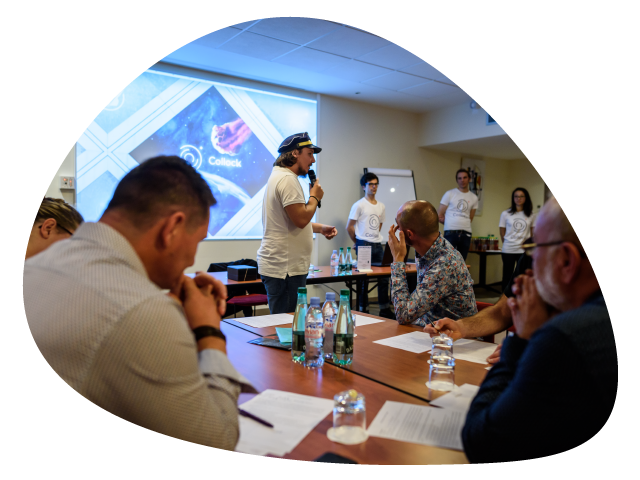
Serious games are an approach that allows you to use games to achieve your professional objectives, and they can therefore offer numerous advantages in this context: improved engagement, better retention of concepts learned, and more. However, you may not know where to begin to apply them to your business. Collock will show you how to use serious games in business.
This article in brief
- Serious games transform training, awareness and collaboration into interactive experiences.
- They help employees learn by doing rather than passively consuming information.
- Serious games can support multiple business objectives, from onboarding to change management.
The advantages of serious games in the workplace
Companies today operate in environments that evolve rapidly. New tools emerge continuously, business priorities shift and employees are expected to adapt faster than ever before. In this context, organizations face a recurring challenge: how can they maintain employee engagement while ensuring that learning and transformation initiatives remain effective? This is where serious games have gained significant attention.
A serious game is an experience that uses game mechanics to achieve objectives beyond entertainment. In business environments, serious games are designed to support learning, collaboration, awareness and behavioral change.
One of the major advantages of serious games is engagement. Traditional training formats struggle to maintain participant attention over long periods of time. Employees may attend training sessions but retain little information afterward. Serious games create active participation by involving employees directly in decision-making and problem-solving.
Another important advantage is the improved knowledge retention. Research and practical experience consistently show that individuals remember more effectively when they actively interact with information. By placing participants in immersive situations, serious games reinforce memorization and encourage practical application.
Collaboration is another significant benefit. Most business challenges require collective intelligence rather than isolated expertise. Serious games naturally encourage communication, cooperation and alignment between participants. Finally, serious games generate emotional engagement. Experiences that trigger curiosity, challenge and reflection tend to create stronger learning outcomes than passive information delivery. But how can you use serious game in your business? Let’s check that.
Potential applications of serious games in business
One of the reasons serious games have become increasingly popular is their versatility. They can support a wide range of business objectives and organizational contexts. Training and skills development remain among the most common applications. Companies use serious games to teach technical knowledge, improve soft skills and accelerate employee development.
Onboarding is another strong use case. Instead of overwhelming new hires with presentations and documentation, organizations can create interactive onboarding journeys where employees discover processes, values and teams through immersive experiences.
Change management is also particularly suited to serious games. Organizational transformations often create uncertainty and resistance. Through simulation and collaborative scenarios, employees can better understand change initiatives and practice adaptation strategies.
Many organizations also use serious games for awareness campaigns. Topics such as cybersecurity, compliance, diversity and inclusion or workplace safety can become significantly more engaging through interactive formats.
Ultimately, serious games become particularly valuable whenever companies need employees not only to understand something, but to experience it.
How to effectively use serious games in business?
Although serious games offer considerable potential, their success depends largely on how they are designed and implemented. And, if you were wondering how to effectively use serious game in business, the first step is defining clear objectives. A serious game should never exist simply because games are trendy. Organizations must identify what they want participants to learn, change or achieve.
Once objectives are defined, selecting the right format becomes essential. Different challenges require different approaches. A simulation may be appropriate for leadership development, while a collaborative workshop or escape-game format may better support team cohesion. Realism also matters. The most effective serious games create situations that participants recognize from their professional environment. When scenarios reflect actual business challenges, learning becomes more meaningful and transferable.
Facilitation should not be overlooked. A serious game is rarely self-sufficient. Facilitators guide discussions, maintain engagement and adapt the experience to participant reactions. Equally important is the debriefing phase. The debrief is where the real learning happens. Participants reflect on decisions, analyze outcomes and connect the experience to real workplace situations. Without debriefing, a serious game risks becoming entertainment rather than development.
At Collock, we believe the most impactful serious games combine immersive mechanics with strong instructional design and human facilitation. That’s why our approach starts with understanding your challenges, objectives and company culture. We then create tailored experiences designed to generate both engagement and measurable business value. Whether your goal is onboarding, awareness, training, change management or team development, serious games become most effective when they are built around real organizational needs.
So, if you were wondering how to effectively use serious game in business, you can remember that all the advantages of this format are revealed through an experience tailored to your business objectives, immersive, and based on a debriefing. Want to go for a custom-designed serious game? Contact Collock!
Frequently Asked Questions
What is a serious game in business?
A serious game is an interactive experience that uses game mechanics to achieve professional objectives such as training, awareness or collaboration.
Are serious games only useful for training?
No, serious games can support onboarding, leadership development, communication, change management, innovation and many other business initiatives.
Can serious games work for remote teams?
Yes. Many serious game formats can be adapted to digital or hybrid environments.
Can serious games replace traditional training?
They can complement existing methods by adding engagement, interaction and experiential learning.
